October 8, 2026 · 8 min read
How to Apply Progressive Overload
Progressive overload means asking a little more of your muscles over time. What it is, how double progression works, and what the research supports.
A training plateau is a stretch of several weeks where a lift stops going up, or a muscle stops growing, even though you're still training regularly. To break one, check the causes in order rather than changing everything at once. Start with recovery, because several nights of short sleep cut strength on big lifts, and eating well below your needs stalls muscle growth. Then look at how you progress, and add reps before weight so each step is small enough to hit. If that's all in place, add a few sets a week, train the stuck lift more often, or swap it for a close variation, such as a close-grip or paused bench press, for a few weeks. A deload helps when fatigue is what's holding you back, but the research so far doesn't make it a plateau cure on its own. Here's the evidence behind each step and how to tell which one you need.
One flat session isn't a plateau. A short night, a stressful day, a missed meal or a rushed warm-up can all knock a few reps off a single workout. I'd look at your log across three or four weeks instead: if the weight, the reps and how hard the sets felt have all stayed put or got worse, you're stuck. Make sure you're comparing like with like, too. The same lift, with similar rest, the same depth and the same pause, is the only fair comparison, and plenty of plateaus turn out to be a squat that got deeper or a bench press with a longer pause than last month. If you don't log how hard each set felt, start now, because a weight that hasn't moved but feels easier is progress, and one that feels harder every week is a warning.
A 2018 systematic review of 17 studies looked at what poor sleep does to resistance training. One night with no sleep at all had little effect on strength, but several nights in a row of shortened sleep could reduce force on multi-joint lifts, such as the squat or bench press, while single-joint exercises held up. The studies were rated moderate or weak in quality, so treat the size of the effect with caution, but the pattern is clear enough: the big lifts seem to suffer first. Food matters for a different outcome. A 2022 meta-analysis of training studies found that people who trained while eating less than they burned gained less lean mass than people who didn't, while their strength gains were comparable, and a deficit of around 500 calories a day was enough to stop lean mass gains. So if you're cutting and your arms have stopped growing, the diet is the likely reason and no program change will fix it, but your strength can still climb. If your lifts have stalled during a stretch of short nights, fix the sleep before you touch the program.
 Photo: KATRIN BOLOVTSOVA, Pexels
Many plateaus come from steps that are too big. Early on you can add weight almost every session, but that pace runs out, and a lifter who keeps trying to add weight every week ends up failing the same weight over and over. The fix is to add reps before weight: stay at a load until you can do a couple more reps than your target on every set, then move up, so each session asks for one more rep rather than a jump you can't make yet. If your gym has fractional plates or small add-on weights, use them on presses and other lifts where the smallest standard jump is a big share of the weight. This alone breaks a lot of stalls, because it turns one big step you keep missing into several small ones you can take.
If your recovery is fine and your steps are small, the next lever is how much you train. A 2026 set of meta-regressions pooled 67 studies with 2,058 people and found that muscle size and strength both kept rising as weekly sets went up, with diminishing returns, and those returns flattened much sooner for strength than for size. Training frequency behaved differently: for muscle growth it seemed to make little difference, but strength gains rose as the same lift was trained more often, again with diminishing returns. That gives you a rule of thumb. If a muscle has stopped growing, add a few hard sets a week for it. If a lift has stopped going up, give it a second session in your week rather than piling more sets into one day, which is where the frequency finding points. Either way, add a little at a time and watch whether your recovery keeps up. The sets per week calculator shows the weekly set ranges for your training experience and whether your split reaches them.
Changing every exercise at once costs you the practice you've built on your main lifts and leaves you unable to tell what helped. A 2022 systematic review of eight studies, all in young men, found that some systematic variation in exercise choice seemed to help strength and the growth of particular regions of a muscle, while frequent random rotation of exercises could hold gains back. In practice, that means swapping your stuck lift for a close variation for a few weeks, then coming back to it. If you've wondered what the close-grip bench press is for, this is its usual job: you keep benching, with your hands a little narrower. The evidence on what it changes is modest. A 2005 study of 12 men, measured while holding the bar still, found that a narrower grip raised triceps activity, though the author called the changes small. A 2017 study of 12 competitive bench pressers found no clear difference in triceps activity between narrow, medium and wide grips, and they could lift about 6 to 11% more for six reps with a medium or wide grip than with the narrow one. So treat it as a slightly different bench press, not a triceps exercise, and expect to use a little less weight. A paused bench press, with the bar held still on your chest for a second, is another close variation, and the same rule applies: keep it for a block of several weeks rather than rotating it every session.
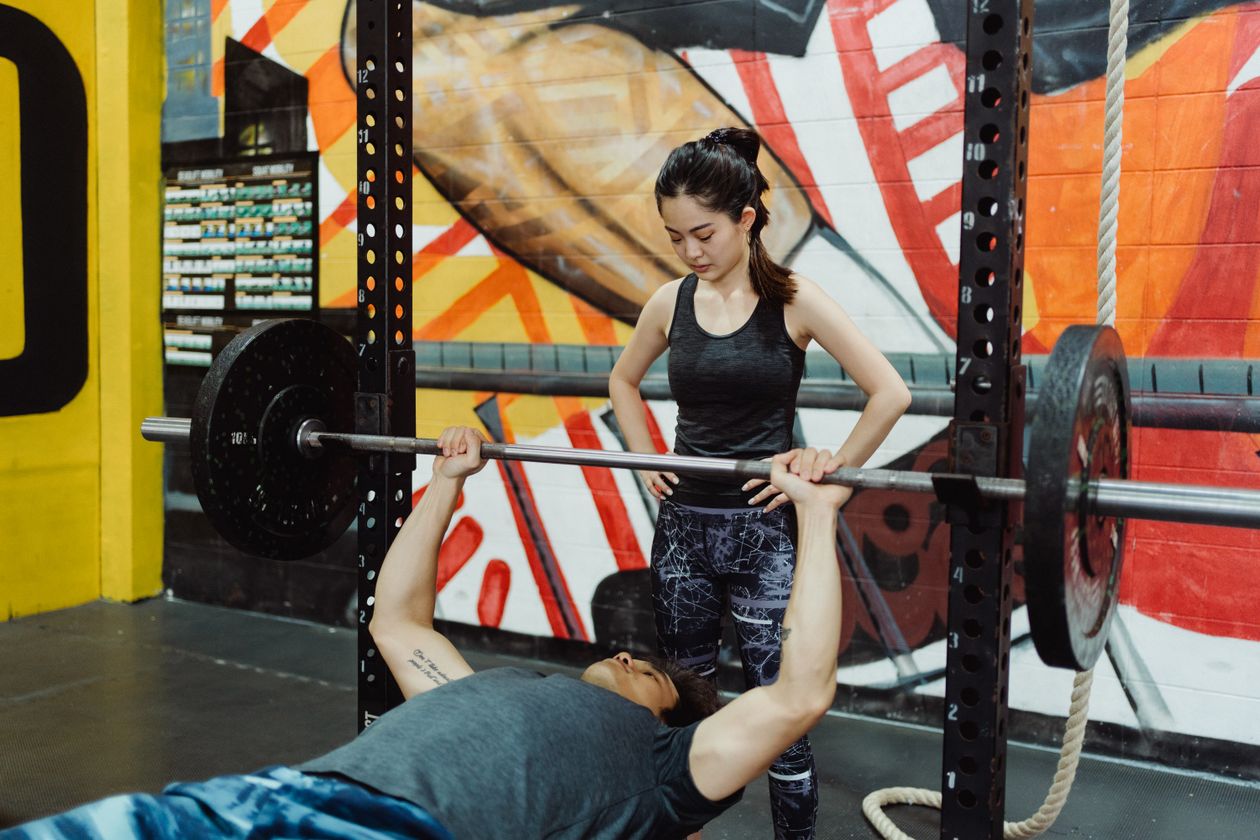 Photo: Ketut Subiyanto, Pexels
A lighter week is the standard advice for a plateau, and it's the right call when you're worn down, but it isn't a reset button. A 2024 study put 39 trained people through a nine-week, high-volume program, and one group took a full week off in the middle. Their legs grew just as much as the group that trained straight through, but the continuous group made bigger gains in lower-body strength and felt slightly more ready to train. Two limits matter here: that deload was a week of no training at all rather than lighter training, and nobody was chosen because they were fatigued. My reading is that backing off doesn't add progress by itself, so it's worth taking when fatigue is what's in the way. If every weight feels heavy, your joints ache and your sleep has slipped, a deload makes sense, and the deload calculator works out the weights, reps and sets for one. If you just feel stuck but fresh, look at the earlier steps first.
You can't see your own lift from the side, and a mirror shows you the one angle that tells you least. A training partner or a phone propped on a bench can show where the bar slows down, whether your hips rise before your chest on a squat, and whether your setup drifts from one set to the next. None of that is a guaranteed fix, but it often turns a vague plateau into a specific problem, such as a sticking point just off the chest or a squat that gets shallower as it gets heavier. If a lift hurts rather than just stalls, see a doctor or physio before you try to push through it.
Workout With Me logs every set with its weight, reps and RPE, and tracks your estimated one-rep max, personal records and per-muscle strength scores, so a stall shows up in your numbers before it has cost you a month. The recovery body map shows which muscles are still recovering from your last sessions. If you want someone to watch your heavy sets, the live map shows workout sessions at gyms and parks near you, so you can join one or host your own, and everything social is free forever. Workout With Me is free to download on the App Store and Google Play.
October 8, 2026 · 8 min read
Progressive overload means asking a little more of your muscles over time. What it is, how double progression works, and what the research supports.
August 19, 2026 · 8 min read
Light and heavy weights build similar muscle if you push light sets close to failure. Heavy wins for a bigger max. What the studies found, side by side.
August 7, 2026 · 7 min read
Compound exercises move several joints, isolation moves one. Which a beginner needs most, where split squats fit, and what the research says about order.