September 28, 2026 · 6 min read
Best AI Workout Apps in 2026
The best AI workout apps in 2026, compared honestly: Fitbod, JuggernautAI, Dr. Muscle, RP Hypertrophy and more, including where each one actually wins.
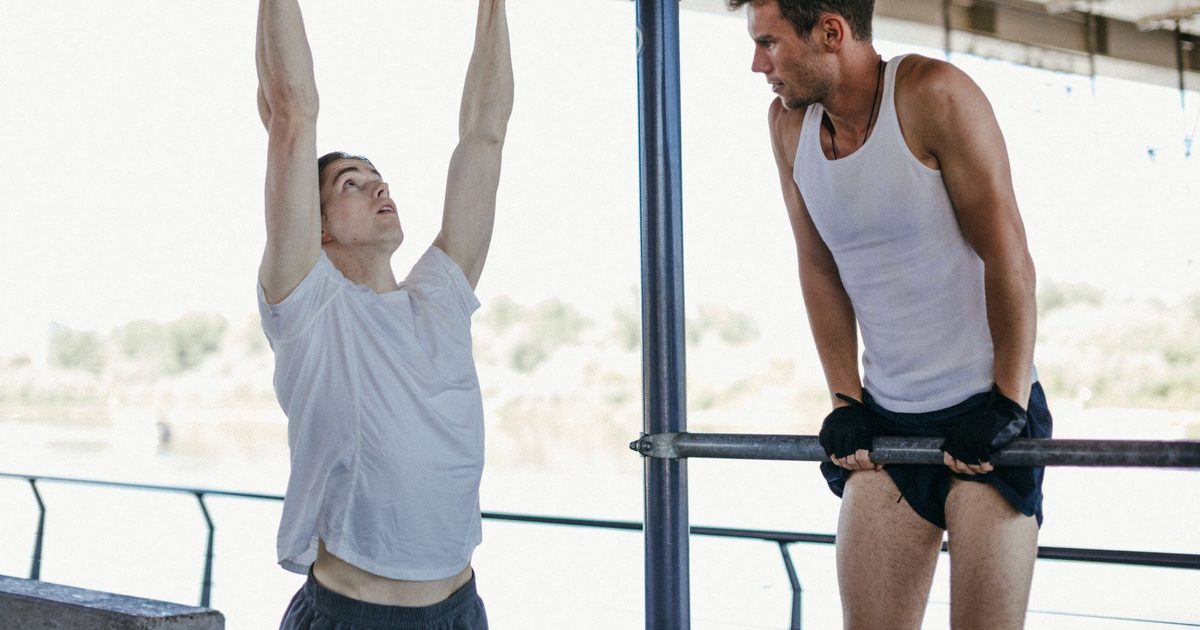
A beginner calisthenics program at the park needs something to pull, something to push, something for your legs and something for your core, three times a week. At most street workout parks that means rows under a low bar, push-ups with your hands on a bench, squats or split squats, and knee raises from the high bar. You don't need a single pull-up to start. Every one of those bodyweight exercises has easier and harder versions, and the whole program comes down to finding the version you can do for 8 to 12 clean reps, then moving one step harder once it gets easy. Below is each movement as a ladder from easiest to hardest, a full park session with sets and rest, and how to know when to climb a rung.
In a gym you make an exercise harder by adding weight. At the park you change the angle of your body instead. A 2011 study measured how hard 23 people pushed into the ground in different push-ups: with the hands raised on a box it was lower than in a normal push-up, and with the feet raised it was higher. The same idea runs through every exercise below. The more upright you stand, the less of your body weight your arms move, and the closer to horizontal you get, the more they move. Your starting rung on each ladder is the hardest version you can do for at least 8 clean reps, or hold for 20 to 30 seconds where it's a hold.
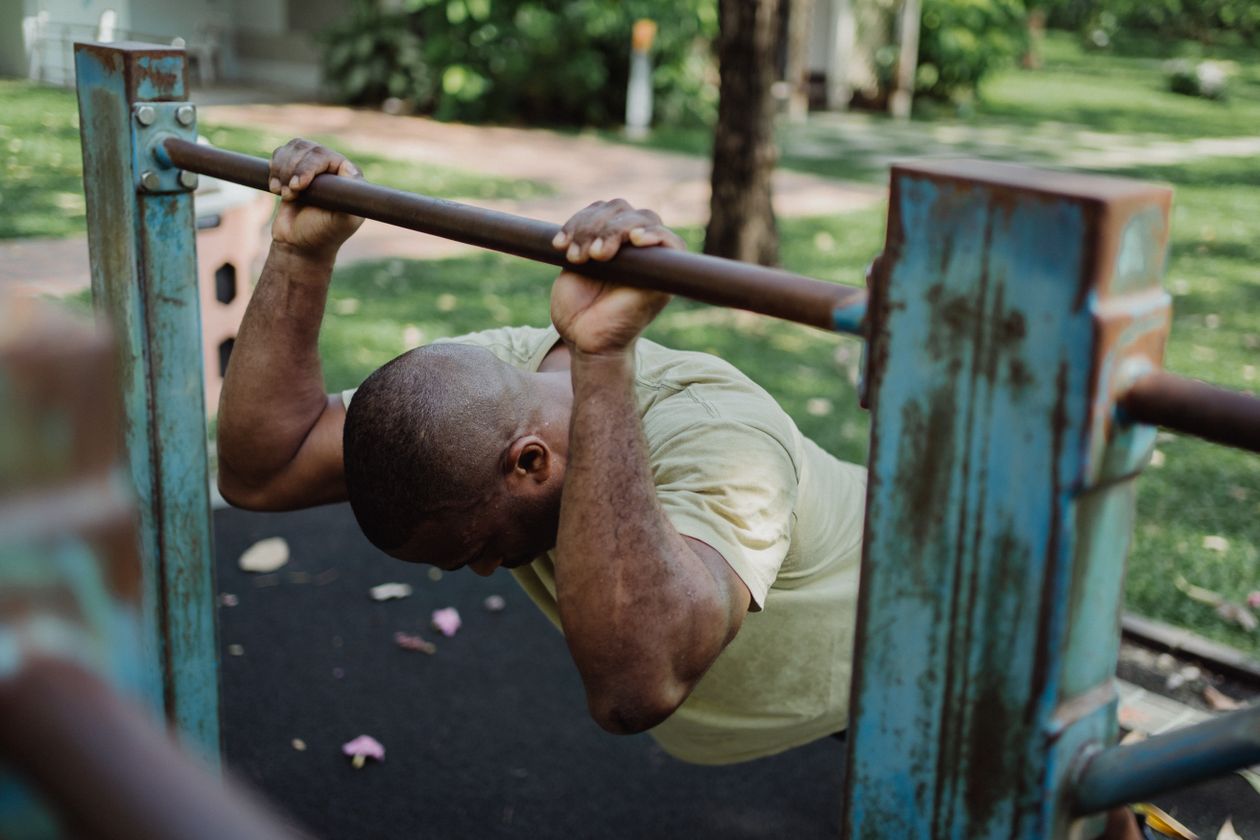 Photo: Ketut Subiyanto, Pexels
Do this session three days a week with a day off in between, for example Monday, Wednesday and Friday. The World Health Organization recommends muscle-strengthening activity on two or more days a week for adults, and the American College of Sports Medicine suggests two to three days a week for people new to resistance training, so three sessions is plenty to start with. Before the first set, walk or jog for a few minutes, swing your arms and roll your wrists, and do a few easy reps of your row and push-up rungs.
| Movement | Sets | Reps or time | Rest |
|---|---|---|---|
| Pull rung | 3 | 8 to 12 | 1.5 to 2 min |
| Push rung | 3 | 8 to 12 | 1.5 to 2 min |
| Legs rung | 3 | 10 to 15 per leg | 1 to 1.5 min |
| Dip rung | 2 | 20 to 30 s holds, or 5 to 8 reps | 1.5 min |
| Core rung | 2 | 8 to 12, or a 30 s plank | 1 min |
You can save time by pairing the first two. Do a set of rows, rest about a minute while you walk to the bench, do a set of push-ups, rest and go back to the bar. Your back rests while your chest works and the other way round, and the whole session fits in 35 to 40 minutes. The dead hang and the support hold are rungs of their own, but they also make good warm-ups once you've moved past them, because they get your hands and shoulders used to holding your weight before the harder sets.
Move up when you can do 12 clean reps on every set of a movement for two sessions in a row. Clean means the full range: chest to the bar on the row, chest almost to the bench on the push-up, and no hips sagging or kicking. The American College of Sports Medicine gives the same kind of advice for weights, recommending a heavier load once you can do one or two reps more than your target, and a new rung is the bodyweight version of that. When you step up, expect your reps to drop back to 8 or fewer and build them up again over the next few sessions. Some jumps feel too big, especially from the row to the negative pull-up. Then make the step smaller: walk your feet a little further forward on the row, or find a lower bar, so you climb in half rungs.
 Photo: Vika Glitter, Pexels
Bodyweight training can build real strength, as long as you keep making it harder. In a 2018 study, 23 moderately trained young men did either progressively harder push-up variations or the bench press, three days a week for four weeks, and both groups raised their bench press one-rep max. Neither group showed a measurable change in muscle thickness in that short time. In a 2015 study of 30 university students with plenty of lifting experience, push-ups made heavy with elastic bands and a bench press at a matched level of muscle activity gave similar strength gains over five weeks. Both studies were short, small and about pushing only, so they don't prove that bodyweight training matches weights in everything. What they do show is the same lesson as the ladders: bodyweight work keeps building strength only while the exercise keeps getting harder, which is exactly what climbing a rung does.
A park has weather. Wet bars are slippery and cold steel is hard on your grip, so after rain dry the bar with a towel or swap the hanging work for push-ups and leg exercises that day. Chalk helps on rough or damp bars, and before you hang from any bar, give it a shake to check it's solid. Bars come in different heights from park to park, so you may need to use the ladder differently in each one: a bench can stand in for a low bar on push-ups, but rows need a bar. If your wrists don't like push-ups on flat ground, holding a low bar or the parallel bars keeps your wrists straight and is often more comfortable. If you have pain in a wrist, elbow or shoulder that doesn't ease after a few days of rest, see a doctor or physio before you go back to the bars. When you're ready for skills like the muscle-up, our calisthenics guide covers those progressions.
Training at a park alone can feel exposed at first, and it's easier when someone else is already at the bars. Workout With Me shows workout sessions at gyms and parks near you on a live map, so you can find a calisthenics partner, join a session or host your own, and that side of the app is free forever, along with logging your sets. If you'd like the app to plan your sessions, the S.H.A.R.P training plans can be set to calisthenics with WWM Pro, from $7.99 a month. The app is on the App Store and Google Play.
September 28, 2026 · 6 min read
The best AI workout apps in 2026, compared honestly: Fitbod, JuggernautAI, Dr. Muscle, RP Hypertrophy and more, including where each one actually wins.
September 2, 2026 · 9 min read
Thirty minutes is enough for a full body session. A lunchtime gym workout timed minute by minute, built on three pairs of exercises.
August 17, 2026 · 10 min read
Dumbbells are enough for a full body workout. Two sessions to alternate three days a week, and what to do when your legs outgrow the weights.